
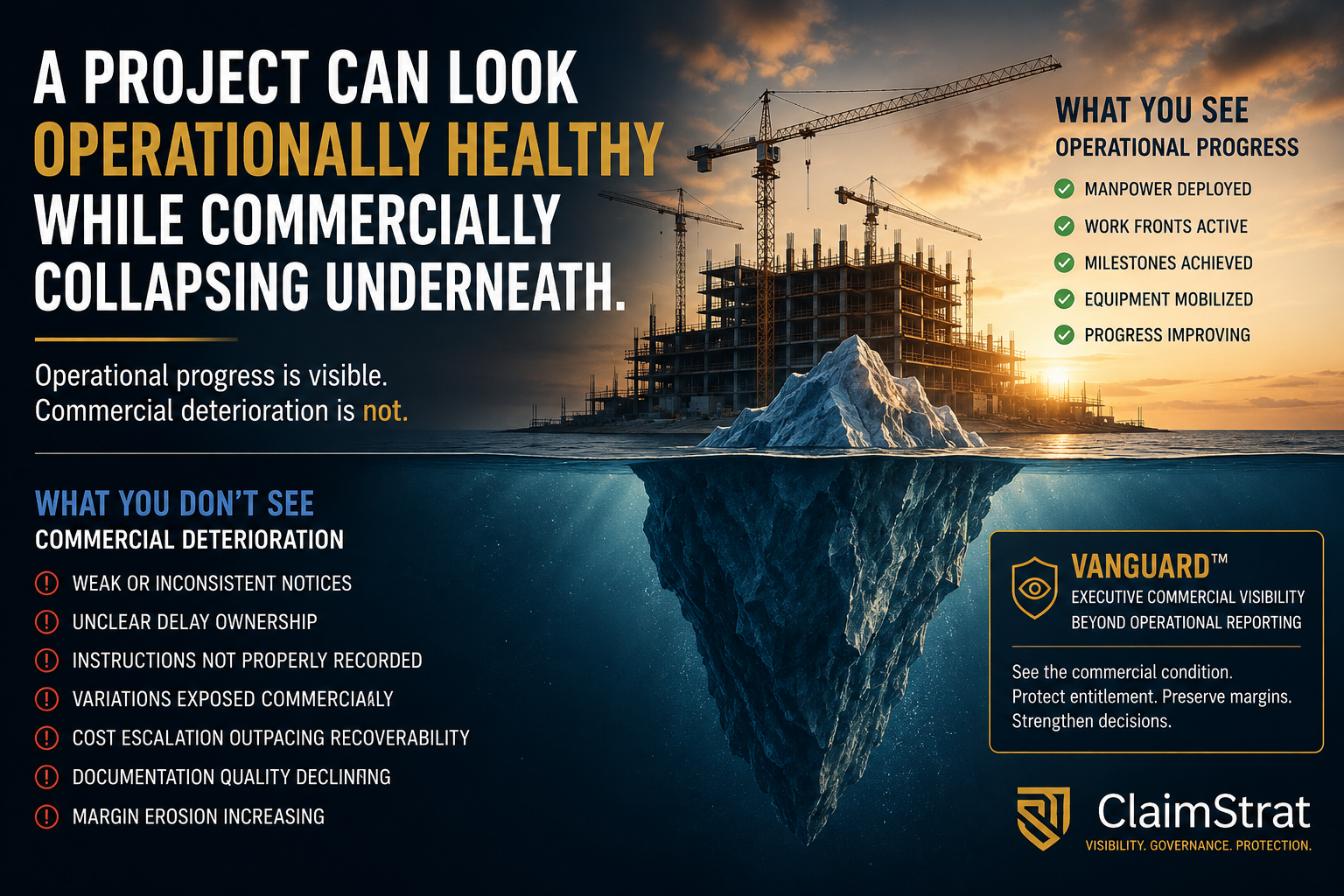
One of the most dangerous commercial blind spots in EPC projects is the assumption that operational progress automatically reflects commercial health. In reality, a project can appear highly active on the surface while commercially deteriorating underneath. Management dashboards may continue showing:
- manpower deployed
- work fronts progressing
- milestones achieved
- equipment mobilized
- percentages improving
Yet beneath that operational activity, entirely different conditions may be developing.
Notices may be weak or inconsistent. Delay ownership may no longer be clearly identifiable. Instructions may be accumulating without proper contractual linkage. Variations may be progressing operationally while remaining commercially exposed. Cost escalation may already be outpacing recoverability. Documentation quality may gradually be declining without immediate visibility at leadership level.
This disconnect between operational reporting and commercial reality is one of the primary reasons many EPC organizations recognize serious exposure too late.
Commercial deterioration rarely announces itself dramatically in the beginning. It usually develops gradually through small governance failures that individually appear manageable:
- delayed escalation
- fragmented communication
- incomplete records
- weak notice discipline
- disconnected planning and commercial functions
- inconsistent reporting structures
Over time, these small gaps compound into larger contractual and financial exposure. One of the common patterns observed across distressed projects is that leadership teams often receive extensive operational reporting but very limited visibility into evolving commercial risk. As a result, executives may continue making decisions based on production momentum while underlying entitlement position weakens steadily in the background.
This is particularly dangerous in high-pressure EPC environments where teams remain heavily focused on physical execution, recovery schedules and short-term milestone achievement. Operational urgency can unintentionally overshadow the contractual and commercial systems required to preserve long-term project position.
Strong commercial governance therefore requires more than progress monitoring alone. It requires structured visibility into:
- entitlement exposure
- notice status
- delay causation
- escalation quality
- variation recovery
- margin protection
- documentation maturity
One of the central principles behind the ClaimStrat VANGUARD™ Framework is that executive visibility should extend beyond operational performance and into the actual commercial condition of the project.
Projects rarely collapse suddenly. In most cases, commercial deterioration becomes visible long before disputes formally arise. The organizations that identify these signals early are generally far better positioned to stabilize exposure, protect margins and preserve strategic leverage before problems become irreversible.
#EPC #ConstructionManagement #ProjectControls #CommercialManagement #ConstructionClaims #FIDIC #ContractsManagement #DelayAnalysis