
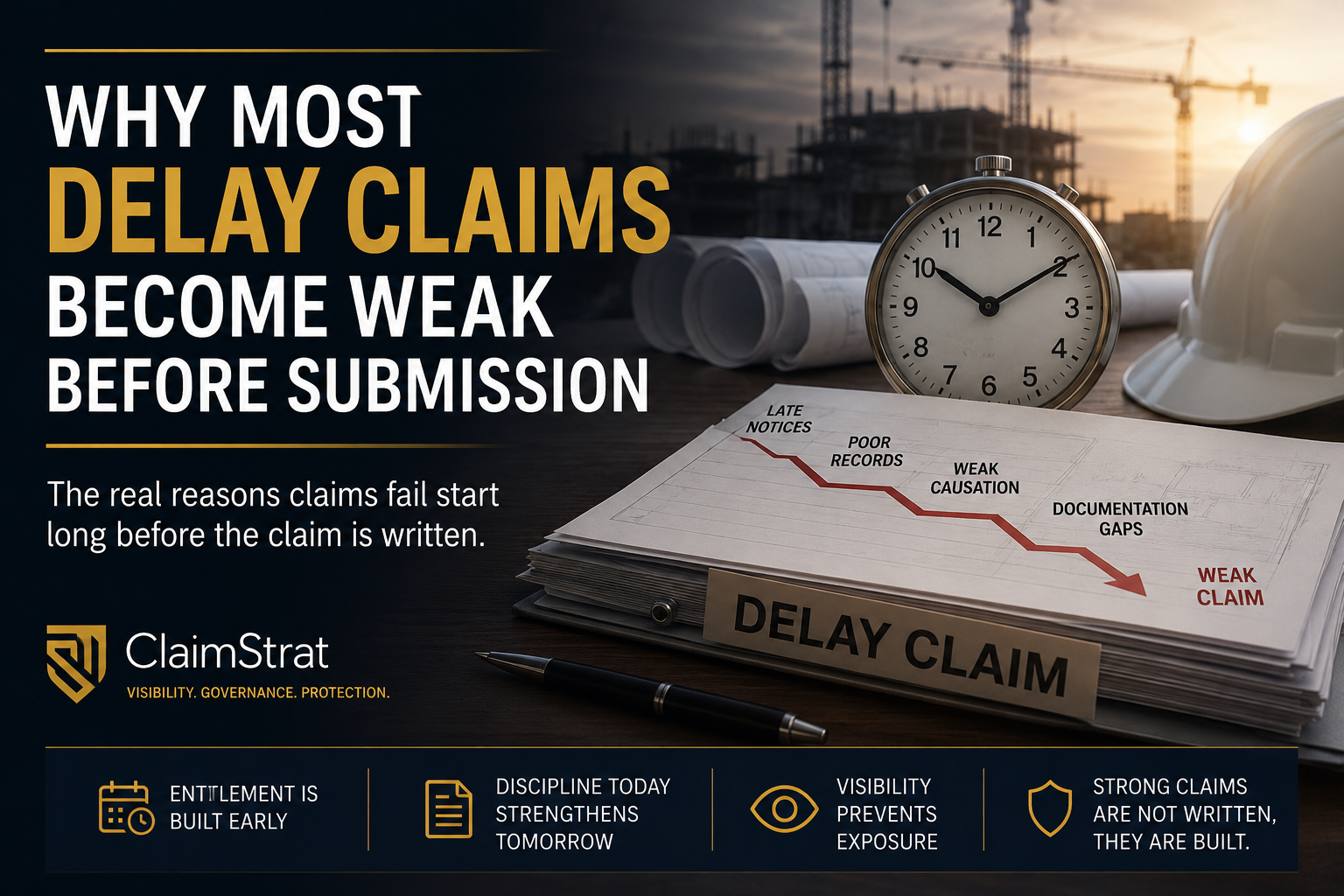
Most delay claims do not fail during arbitration or formal dispute proceedings. In many EPC projects, they begin failing much earlier — often during routine execution, long before management realizes the seriousness of commercial exposure.
By the time a contractor formally starts preparing an Extension of Time claim or a cost recovery submission, the project may have already lost a significant portion of its contractual leverage. Not because entitlement never existed, but because the systems required to preserve and support that entitlement gradually weakened over time.
This usually happens quietly. Delay events are not consistently tracked. Notices are issued late or without strategic linkage to contractual obligations. Instructions are received informally and never properly documented. Planning teams continue updating schedules operationally while commercial implications remain disconnected from the broader project narrative. Cost impacts are recorded without sufficient causation analysis, and critical issues are escalated only after the commercial position has already deteriorated.
What makes this particularly dangerous is that the project may still appear operationally healthy. Physical progress continues, manpower remains deployed, work fronts remain active and reporting dashboards may still present an acceptable picture of execution. However, underneath that operational activity, entitlement visibility may already be weakening. Delay ownership becomes increasingly difficult to establish, documentation gaps begin accumulating and the recoverability of costs and time gradually declines.
One of the most common misconceptions in the industry is the belief that claims preparation begins near project completion. In reality, claim strength is built progressively throughout the life of the project. Every notice, instruction, record, schedule update, escalation decision and communication contributes to the eventual commercial position of the contractor.
A well-written claim document cannot fully compensate for months of weak commercial discipline during execution.
This is why many projects enter disputes believing they possess strong entitlement, only to later discover that the underlying contractual foundation has already been compromised by fragmented records, inconsistent notices and weak linkage between project controls and commercial management.
In complex EPC environments, commercial deterioration rarely occurs suddenly. It develops gradually through small governance failures that individually appear manageable but collectively create significant exposure over time.
One of the central ideas behind the ClaimStrat PRISM™ Framework is that these patterns are often visible much earlier than organizations realize. Projects usually provide warning signals long before disputes formally emerge. The challenge is not always the absence of information, but the absence of structured commercial visibility capable of identifying these signals early enough to allow meaningful intervention.
Organizations that improve this visibility are generally far better positioned to preserve entitlement, strengthen recovery potential and protect project margins before commercial deterioration becomes irreversible.
#EPC #ConstructionClaims #DelayAnalysis #FIDIC #ProjectControls #ConstructionManagement #ContractsManagement #CommercialManagement